No bridge too far for Birdon
Cummins is partnering with Australian family company Birdon on major US defence contracts involving hundreds of engines.
When Jim Bruce was a kid all he dreamed about was being a truck driver. That dream turned to reality in the 1960s and he went on to own his own truck, eventually giving him the encouragement to broaden his business horizons.
The company he established in 1977 in Port Macquarie, New South Wales, was called Birdon, and what has ensued can only be described as one of the most remarkable achievements in Australian business.
It’s the story of a small Australian family-owned marine engineering company shrugging off the minnow tag to become a serious player in the US marine defence market, successfully bidding against globally recognised defence contractors.
Not so small now with more than 500 employees and growing all the time, Birdon was founded when Jim Bruce, after giving up his career in trucking, bought a single dredge to extract sand from the Hastings River at Port Macquarie.
Sadly, Jim hasn’t seen the extraordinary achievements of Birdon under the leadership of son Jamie as CEO and daughter Tammy as CFO, having passed away from cancer in 2008.
Prestigious contracts
In recent years, Birdon has secured prestigious contracts with the US Army and US Coast Guard worth more than US$2 billion, while its Port Macquarie facility is still world headquarters for the company.
The company slogan ‘Make It Happen’ says it all.
The Bruce family’s long relationship with Cummins started in the 1960s through Jim Bruce’s trucking aspirations when the iconic NH250 was his engine of choice.
“Creating relationships is very important in business,” Jim said in an interview in 2005. “You need faith in the people you are dealing with, so you establish a relationship and you move ahead. That has happened in our relationship with Cummins.”
The Bruce family’s strong relationship with Cummins continues today in no small way: the 800th Cummins QSB6.7 engine rated at 250 hp was delivered early this year to Birdon for the bridge erection boats (BEBs) it is building for the US Army at its Denver headquarters in the US.
These twin-engined waterjet boats are used to help the army erect temporary bridges in warzones and for disaster response and are based on a design Birdon developed in the early 2000s when it won a $15 million contract to supply the Australian Army with 24 Cummins-powered BEBs.
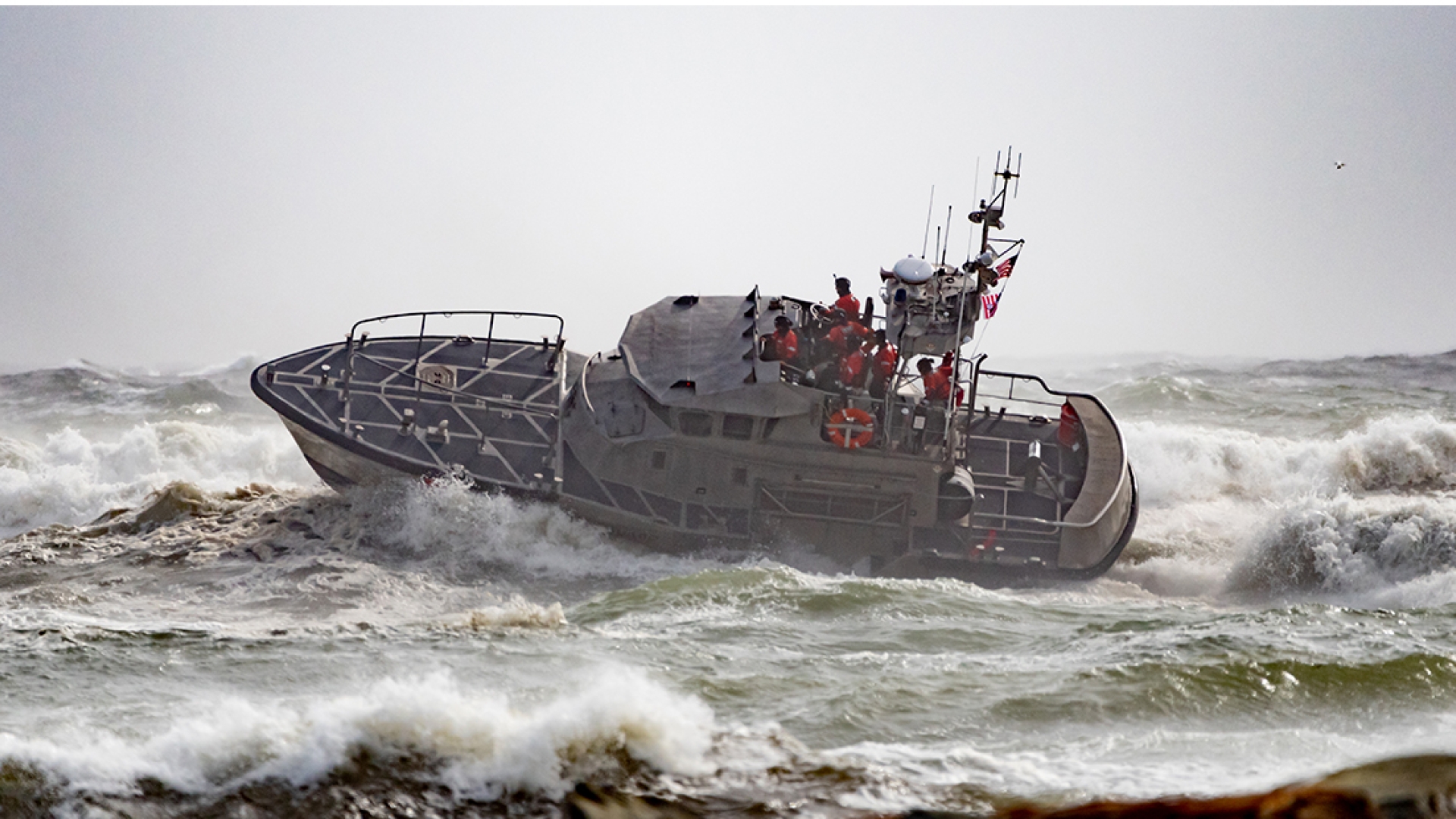
Birdon is also taking delivery of 234 Cummins QSC8.3 engines rated at 530 hp for the US Coast Guard Motor Lifeboats (MLBs) which it is upgrading under a service life extension program.
These twin-engined vessels are an important part of the Coast Guard’s national security strategy, and as an all-weather fast response vessel are used to patrol vast areas of the country’s coastline. They are designed to operate in extreme hurricane force conditions and are rollover capable. Qualifying for the upgrade meant the Cummins engines, in the event of a rollover, had to be able to continue running and be ready to power the boat ahead.
The most recent US Coast Guard contract, announced in October and valued at US$1.187 billion, is to design and build 27 Waterways Commerce Cutters (WCC), each vessel featuring five Cummins engines – two QSK19 main engines, two X15 auxiliary engines and one emergency QSB6.7.
These WCC vessels will maintain and protect the United States’ vital inland waterways through which 630 million tons of cargo move annually, accounting for more than US$5.4 trillion annually and 30.7 million jobs.
Massive challenges
Media announcements about Birdon’s success in the US, where it will soon be operating four facilities, make no mention of the massive challenges the company faced in dealing with competition described as “cannibalistic” by Birdon America president, Rob Scott, a US Marine who served in Afghanistan.
The actions of dishonourable partners nearly sank the company’s efforts to win the BEB contract which it eventually secured in 2014 after four years of design, tender submission and prototype trials. Birdon had to establish a workforce and manufacturing facility, secure finance, obtain security clearances with the US military which required massive resources, handle rising input and wage costs, and so the list goes on.
A crucial element in Birdon’s bid to win the BEB contract was its last-minute acquisition of North American Marine Jet, or NAMJet, whose waterjet technology was found to provide exceptional thrust-per-horsepower coupled to Cummins’ QSB6.7 engine.
“The owner of the propulsion system we used in the Australian BEB design tried to force us from the US competition by teaming exclusively, at the last minute, with one of our competitors,” recalls Jamie Bruce. “As it turns out, they did us a big favour. Not only did we go on to win the contract with NAMJet as part of our design, but we now also own a unique piece of IP that is being used in vessels around the world.”
Back home in Australia, Birdon’s enduring roots in Port Macquarie see a wide range of civil and military projects being carried out there, including construction of Cummins-powered Regional Patrol Craft for the Australian Defence Force, construction of firefighting vessels for the Port Authority of NSW, refitment of the last of 10 First Fleet-class ferries operated on Sydney Harbour, and the design and build of the New Young Endeavour – the Royal Australian Navy’s three-masted sail training ship that will replace the existing vessel that has been in service for 30 years. The new generation vessel will provide decades of education and experience to thousands of Australian youth.
Family owned – forever
“We have no desire to be anything other than family owned, it’s what dad would have wanted,” says Jamie Bruce with a definite tone of pride, when asked if Birdon will stay a family company.
We do our best to maintain a strong family culture based on the way we treat and care for one another."
“We’ve been careful to pursue programs which we believe we have a high chance of winning and we’ve also been patient, not trying to bite off more than we can chew. Obviously in any market, it also takes hard work, tenacity…and the best people.”
Author Profiles