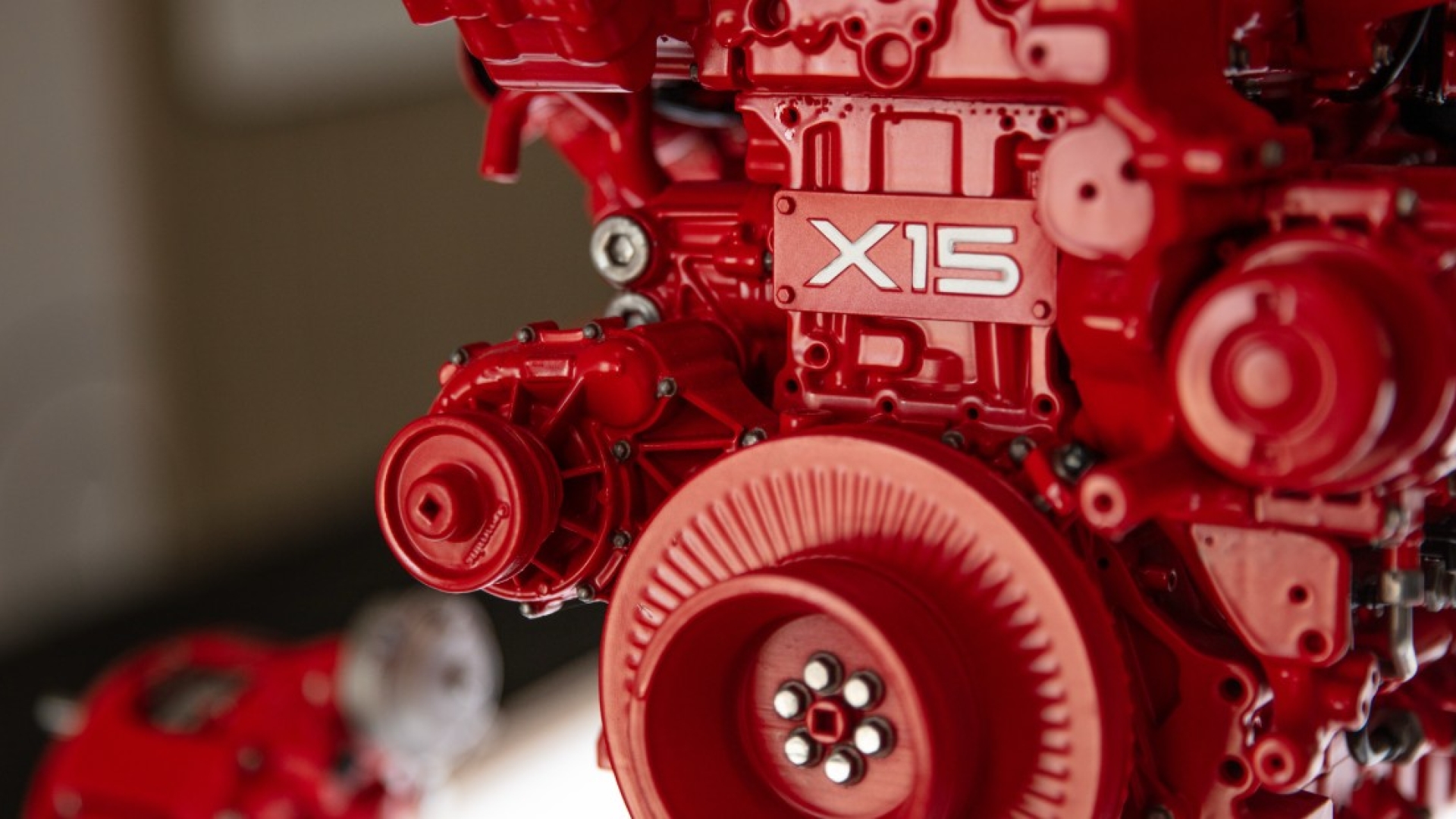
Rising to the challenge with the 2027 X15
Key Points
-
How predictive diagnostics help fleets plan maintenance before issues disrupt operations
-
Why full powertrain integration can unlock measurable gains beyond engine limits
-
How data insights guide fleets to operate equipment more efficiently and safely
Heavy-duty engines are no strangers to hard work. Every mile, every load, every job depends on performance that holds up in the real world.
In this episode of Power Onward, Kim sits down with Adam Whitney, GM Regional Fleet Sales, North America, and Brad Sutton, Executive Director, Powertrain Engineering, to look at what keeps fleets moving and why the X15 continues to earn its place on the road. The conversation moves beyond the engine itself into the full powertrain, where integration, data, and real-time insight shape how trucks perform day to day.
Adam shares what customers ask for when they spec a truck and why uptime, fuel efficiency, and total cost of ownership still define success. Brad explains how powertrain integration pushes performance further, from fuel savings to driver safety, and how data is changing the way fleets plan, maintain, and operate.
This episode shows how Cummins supports customers across the full lifecycle, from initial spec to long-term optimization. These efforts help fleets move everything from food to fashion — keeping shelves stocked and supply chains flowing.
Watch
Additional resources
Videos
Timestamps
(00:00) This is Power Onward
(00:13) Why performance matters in real-world operations
(01:20) What makes the X15 a trusted platform over time
(02:40) What fleets look for when specing a truck
(05:00) How predictive diagnostics is changing uptime
(06:05) Thinking beyond the engine to full powertrain integration
(08:08) Hidden advantages customers may not consider
(09:40) How partnership supports fleets across the lifecycle
(10:40) Turning data into uptime and cost savings
(12:20) Moving from reactive fixes to predictive maintenance
(14:40) Helping customers operate equipment more effectively
(15:00) What the next generation of powertrain will bring
Listen
Apple Podcasts | Spotify | Amazon Music
Transcript
Episode transcript
Show ID (00:03):
Welcome to Power Onward, the podcast that pulls back the curtain on the technologies, people, and partnerships shaping the future of power.
Kim (00:13):
When you see heavy-duty machinery hard at work, on the highway, at a job site, or in the field, it's easy to just see equipment in motion. But for the people who rely on it, the machine represents something much bigger, productivity, profitability, and the pressure to perform every single day. Across industries, performance isn't theoretical. It's proven in the real world, and that's why millions of applications around the globe run on Cummins, delivering the kind of durability that can go a million miles and beyond. For over a century, Cummins has built deep expertise across on highway, industrial, and vocational environments. And that experience doesn't just shape our products, it shapes how we think about what's next. I'm joined today by two extraordinary colleagues to give us a scoop on the Cummins X15. And spoiler, this isn't just about the engine itself, it's also about the evolution of the powertrain and delivering solutions that meet customers where they are today while preparing them for what's ahead.
(01:08):
I'm Kim, global brand manager here at Cummins.
Adam (01:10):
I'm Adam, general manager of our regional fleet sales and support team.
Brad (01:14):
And I'm Brad Sutton. I lead our powertrain engineering organization.
Kim (01:17):
So Adam, now that I've mentioned the X15, we got to admit it's built quite the reputation over the last few years. From your work with various fleets, what are you hearing from the customers and what keeps them coming back to this platform?
Adam (01:29):
I think it's the legacy that the engine's built, as you alluded to it. Over 25 years now, launched the ISX originally back in the late 1990s, and it's just established itself as a workhorse and a champion in the on-highway space in North America. Iterations of the product through regulatory changes and emissions, regulations, hardware added to the engines. And while there's been bumps in the road along the way, we've always been able to refine the product and make it reliable, durable, and efficient, which is what our customers expect.
Kim (01:58):
I like the real time, just figuring it out on the go. Things need to get better, we'll make it better, that reassurance. Absolutely. Yes. Brad, do you have anything to add to that?
Brad (02:05):
Well, it has been a history. In fact, I was here for the launch of that original engine dates me a little bit. If I think about the evolution of that product, it has become kind of the center of a lot of our fleet's productivity, and that's what it's about, productivity. And driver assistance, driver satisfaction, these are the things that are important. And people keep coming back to Cummins and keep pulling Cummins products through our OEMs because of that. Drivers want to drive a reliable engine. They make their livelihood off of us and there's nothing more important than that.
Kim (02:39):
Adam, when fleet managers and operators are spec’ing a truck, what are some of the top three things that they're looking for and how does the X15 help them win on those priorities?
Adam (02:47):
Great question, Kim. I think there's numerous factors that go into spec’ing equipment, and I would say fleets look at a wide range depending on what their requirements for their business are. But what we see constantly across all of our customers and their needs is first would be uptime and reliability. Unscheduled downtime is just so dangerous for a customer. It costs them significantly. So it's important on us and in all of our design to make sure that we're giving them a reliable and durable product that can help them satisfy their customers and have their drivers go out on the road and come back home safely. After that, and I would say a very close second is fuel efficiency. Right, that ties to the bottom line of a fleet. We compete on fuel efficiency every day, and that's what customers expect. And tying those two together, I would say overall total cost of ownership.
(03:30):
Again, the more time you're on the road, the more efficient you are, more fuel efficient, but tying in maintenance intervals and maintenance costs all factor into total cost of ownership. And I would say those would be the top three things that fleets would consider.
Kim (03:42):
I love that you also mentioned getting the drivers home safely. Absolutely. I think that so much of the time we think about the cost, the metrics, the uptime, the downtime we don't really think about or we think about, but not many people think about how we want the drivers to be arriving safely at home to their families. Very
Adam (03:56):
Important.
Kim (03:57):
I think I had kind of alluded to this, but when we reference our customers, I do think that many people think about those larger fleets, right? But the reality is the industry is growing and we've got fleets of all types of sizes, including some midsize fleets that are growing quickly. Does the X15 serve both large enterprise accounts and those mid-size operators as well?
Adam (04:15):
Absolutely. And I think that's one of the value propositions of Cummins is we serve all customers in all types of applications. We have regular line haul types applications, but we service severe duty, heavy haul applications, vocational applications, and the X15 can be built and designed and trimmed in a manner to support all those customers and all of their specific needs. And even within those specific applications, customers will have different needs as well. Whether again, it's more leaning towards performance, more leading towards fuel efficiency or a balance of the two. We'll work with customers to make sure we're specing the equipment right and setting it up to help them meet their needs.
Kim (04:51):
Brad, I'm sure you and your team are always working on this type of stuff. What would you like to add to that?
Brad (04:55):
Well, if you think about the other piece of the dynamic customer base that we have, a lot of it is about uptime, as Adam has said many times, right? And where we come into play there is being able to provide uptime to any size customer. In that particular asset, we are able today, because of the powertrain, able to predict when something will fail. We can help people manage their uptime by plan it on your own time, don't wait for it to break down. And in some cases, we can actually fix it without them even knowing because of the capability of our products today. That has shifted over the past 25 years. And today I would say that predictive diagnostics or what we would call a more optimized repair because of the data that we have, which by the way, is key with the X15, has really changed the dynamic across those customer spectrums and people really look for that in their products.
Kim (05:52):
So Brad, as you've mentioned, the X15 doesn't just operate solo. There's an entire powertrain solution that's accompanying the X15. So how is Cummins thinking differently about how we build things now, all of it in integration?
Brad (06:05):
We can really go down a lot of different paths on that, but let's pick fuel efficiency to begin with. Physics limits what an engine can do. Like it or not, we're the best at designing engines, but it does have a limit. But how we optimize on top of that with our full powertrain solutions, whether it be transmission integration, whether it be how we manage thermal management of the entire system, braking, axles, how we spec a truck, not just spec an engine, but spec a truck, and help operate that can bring three, five, another 7% in some cases in fuel economy. So when you think about that, that is where the powertrain comes into play. We get much better on top of what is already an industry-leading engine. And when you can make that better, no one can even touch us.
Kim (06:53):
I know that we're talking about the powertrain. It's more than one component, but it's very much like a dynamic duo. Yeah. Can't have one without the other and they fortify each other.
Brad (07:00):
Absolutely. Well, we just optimize on top. And then if you add axles to it and different axle ratios and braking systems, now we're not even just talking fuel efficiency. Now we're talking about driver assistance, drivability. And what is becoming the new fuel economy in my world is driver safety. And when you can tie all of those things in together of whether you're braking the engine, downshifting a transmission or using foundational truck brakes to keep a driver safe ahead of time, that's the top of the world.
Adam (07:31):
Yeah. And I would just add, I think, as you've alluded to, it's so important to be able to integrate all these components to be able to give customers the one solution that they're looking for, and that's what they are looking for Cummins to do is to be able to integrate and provide them an optimal solution.
Kim (07:46):
I like that you say the one solution, but it's never like a one size fits all solution from what I've heard you say when we spec these things together, maybe it's a hint of this, a hint of that, but it's like no one build is ever the same. It's exactly what they need for, and then that's essentially it. That's how we serve them.
Adam (08:00):
Exactly.
Kim (08:00):
So what is something that Cummins does differently from a powertrain standpoint that the customers may not be able to see that makes an incredible difference?
Brad (08:08):
Well, I wouldn't say that customers cannot see it, but they may not think about it in the beginning. When you think about the heavy-duty trucking industry in North America, right now I think two years ago, 169,000 Class 8 trucks involved accidents, not caused by trucks, but involved accidents. So how do we keep drivers more safe? And if you think about the curve of the safest drivers in the industry to the maybe least safe drivers in the industry, the powertrain being integrated with braking systems and transmissions can help all drivers operate at the safest level. So when we think about the features that we create and what we do, the next generation, and even today, we drive all of those features mimicking those safest drivers. That is what fleet owners really want. And that's what drivers want too, because it makes their job much more easy.
(09:04):
They can pay attention to what they're trying to do, which is deliver the next mission, and we keep them safe along the way. And that is really what the optimal powertrain does outside of fuel efficiency. They always start with fuel efficiency, but then we give them these added bonus items, right? Things like driver assistance, driver safety, integration with other systems on the vehicle, and that's what differentiates us from everyone else. So we
Kim (09:29):
Have a powerful engine in the X15 and this fully integrated powertrain, right? So the dynamic duo, the match made in heaven. When customers choose Cummins, what keeps them coming back in this dynamic landscape?
Adam (09:40):
I think it's the partnership with their OEM partners. We have a team that wants to work with customers, partner with Cummins to help them, A, optimally spec a product to meet their equipment needs, then make sure it's set up to operate the way they want it to, whether it's for driver performance and whatnot, and then constantly be with the customers through that lifecycle of that product. Being able to support them, continue to make sure that they're efficient, maximizing their uptime through various tools. And as Brad mentioned earlier, the telematics and the information we get, it can actually be overload for many customers. So how can we help them manage that and be more efficient as they're operating our equipment up and down the road every day?
Kim (10:18):
What I like about what you've said so far is we're there for the spec’ing, there for the design, there for the tinkering, for any test drives, and then you said every step away for the lifecycle of that product. That's
Adam (10:29):
How we view it. We really want to view it as a partnership with customers.
Brad (10:32):
Just to build on to Adam's comment around uptime, just some data. I'm a data guy, so I like data. In the past couple of years, we have saved over 200,000 hours of labor and downtime for our customers via the data that we have. And like Adam said, sometimes that can be confusing and overwhelming, but we have the ability to give our customers insights on how to manage their equipment in the best way possible. And when something does happen, the rare occasion when something happens, we get it back on the road as quickly as possible. That's all enabled by this data-driven kind of uptime approach that we have inside of the company and with our products, with our full integrated powertrain, so that we can diagnose and get that customer back on the road as quickly as possible to do what they get paid to do, which is complete their mission.
(11:20):
So that is a big differentiator with us. And I think Uptime has been always something we talked about. We talked about it at the launch of the X15. In fact, there was an uptime guarantee that some of us were part of. Now we have a data-driven approach to that that allows us to drive every customer regardless of their size to maximize the uptime they have.
Kim (11:41):
Now, when you said 200,000 hours, is that correct? Yes. 200,000 hours, all I can think about is dollar signs.
Brad (11:48):
Absolutely. Dollar signs costs. I can internalize how much that is, but the reality is it's over about $38 million that we've saved. And if you put that in customer dollar numbers, it's even bigger. I think an average in Adam could probably help me, but the last I looked was most of our customers for a day down is $1,000 they lose.
Kim (12:07):
Wow.
Brad (12:07):
So when you can start to chip away at the hours that they're down, which our data-driven approach does, it really saves them money, gives them uptime and creates a better experience for everyone.
Kim (12:18):
Yeah. It's just like with people, prevention is always easier than treatment. So we've talked a lot about tailored support for our customers, right? We've also nodded to and alluded to maybe reactive versus preventative maintenance. So what are some other ways that Cummins is helping customers stay ahead of it?
Adam (12:32):
Yeah, I think really through the advent of telematics and the addition of that into the equipment, we have so much more data now. And we mentioned earlier, it's critical for a fleet to minimize unscheduled downtime. It's just so damaging to their business and their operational efficiency. So now we have data that not only do we know, hey, there's a fault code, so we can tell a customer that they have a fault code. We can tell them, is it critical or not? Can they go and complete their load or they need to pull over and get service right away? And now getting into the prognostic space, we're able to look at the engine in real time constantly and be able to tell a customer, "Hey, we're seeing something that doesn't quite look right. We'd like you to get it looked at at your earliest convenience." So don't pull it off the road, don't disrupt a driver mission, but when it's in for service next within the next 30, 60 days, have it looked at.
(13:20):
And that's where we really move from reactive to predictive maintenance and fleets can now plan around that downtime and get work done when it's convenient for them.
Brad (13:29):
Yeah. And just to add on to what Adam, he's talking about one of the most critical things Uptime, but that same data helps us help a customer think about their equipment in a better way. An example, we may see a trend in the data that says, "Boy, this feature could really help them operate at a much more efficient level." Let's offer to them that maybe they ought to turn this feature on or maybe they should tweak how they operate. Maybe they should change what their top end speed is. Maybe they should change a feature which is a predictive feature that could help them save X amount of fuel, or maybe they should be implementing a different driver safety function. That to us is really helping that customer operate their vehicle in the best way possible on top of trying to help predict uptime, it also helps them get a better piece of equipment overall.
Kim (14:20):
I didn't even think about that aspect of helping our customers. I frequently think of when I see my check engine light and I'm like, "Wow, this is going to cost a lot. It's so inconvenient." I didn't even think about the optimization of how our customers could be working better, more efficiently and saving more potentially.
Brad (14:37):
Using our products in the most efficient, effective way possible, and we can help them decide how to do that in the best way.
Kim (14:44):
All right. So it all comes back to that proven reliability we've been discussing this entire conversation, right? I feel like today customers are faced with a lot more complexity and a lot more options. So how are we more of that trusted partner versus just a point of contact for our customers?
Brad (14:59):
Well, when you think about what we were just talking about earlier in terms of the data available to us, that is a game changer. And when I was a young engineer, I wish I would've had all this data at my fingertips, but today we have so much data to help our customers operate their equipment better, make sure that when something happens, it gets back on the road faster, or maybe as Adam mentioned earlier, completely avoid it. And that is a differentiator for us in helping our customers. Giving them that real experience that they need at their choice and giving them more choices and helping them make those choices in the best way possible, depending on their needs, whether it's fuel economy, whether it's performance, maybe it's simply uptime, maybe they don't care about the other things, or it is we need the ability to help that driver operate that vehicle in a more safe fashion.
(15:52):
It can be all of those things. We are integrated so deep with those customers now because of that data that we have that it's just a game changer versus 25 years ago when this engine originally launched. The next generation of it only gets better. I wish I could give you more details about what's getting ready to come about, but it even gets better, more integrated, more data, more capability, and it's going to be the best product that comes a scene so far.
Kim (16:18):
Brad, Adam, I'm going to throw out two options. You tell me which one you'll pick. Yeah?
Adam (16:23):
Absolutely.
Kim (16:23):
Okay. First one, torque or fuel efficiency?
Adam (16:26):
Driver safety. I'm going to sit on the fence in that, and I think it's give them the fuel efficiency when we can, but give them the torque when they really need it.
Kim (16:33):
Predictive diagnostics or scheduled maintenance.
Adam (16:36):
Avoid all the above. I think scheduled maintenance, right? If we can, A, avoid it all, but there's going to be maintenance that's going to have to happen on the equipment. If we can give them time to schedule, it's critical for our customers.
Kim (16:46):
Driver satisfaction or fleet efficiency?
Adam (16:49):
Both. I agree.
Kim (16:51):
Integrated powertrain or mix and match components.
Adam (16:54):
Both. Integrated powertrain.
Kim (16:56):
Lower purchase price or lowest cost per mile.
Adam (16:59):
Lowest cost per mile, and that's how our customers look at it.
Brad (17:00):
Cost per mile all day, every day.
Kim (17:04):
Thank you both for joining us today. Really appreciate you guys stopping by to share some insights and also just display how Cummins keeps the world moving.
Brad (17:11):
Yeah, thank you, Kim. Thanks, Kim.
Kim (17:13):
Okay. So what's the big idea for this episode? Across industries, whether it's on highway, on a job site, or in the field, the pressures are remarkably similar. Fuel efficiency, serviceability, operator confidence, and long-term value. And what we've heard today is that meeting those demands takes more than a great engine on its own. It takes a fully integrated powertrain, designed to work as a system and packed with data and insights to help anticipate issues before they arise. The evolution of platforms like the X15 isn't just about advancing technology, it's about building solutions that grow with a customer in partnerships that deliver confidence where it matters most because at the end of the day, it all comes down to one thing, customer confidence, earned through performance and proven over time.
Show ID (17:56):
Thank you for listening to Power Onward. Your support means the world to us. If you enjoyed this episode, please don't forget to subscribe, rate, and review on your favorite podcast platform. If you want to dig deeper on what we covered today, check out the show notes for additional links or go to Cummins.com/podcast. Until next time, power onward. We're from Cummins, the company that's been innovating toward the future for more than a hundred years. We're no strangers to rapid change, global shifts, and economic uncertainty. We want to be your constant during the energy transition. Whenever, wherever, forever. Power Onward.
For more episodes, check out cummins.com/podcast. Want to join us on our mission towards smarter, cleaner power? Check out cummins.com/careers to explore opportunities.
Author Profiles