Smarter systems for a changing grid
Key Points
-
Why BESS works best alongside generators, renewables, and the grid
-
How BESS can cut fuel use, smooth peaks, and reduce outage risk
-
Why data centers and AI are driving demand for faster, more flexible power
When power demands get more complex, the answer is smarter integration rather than more technology
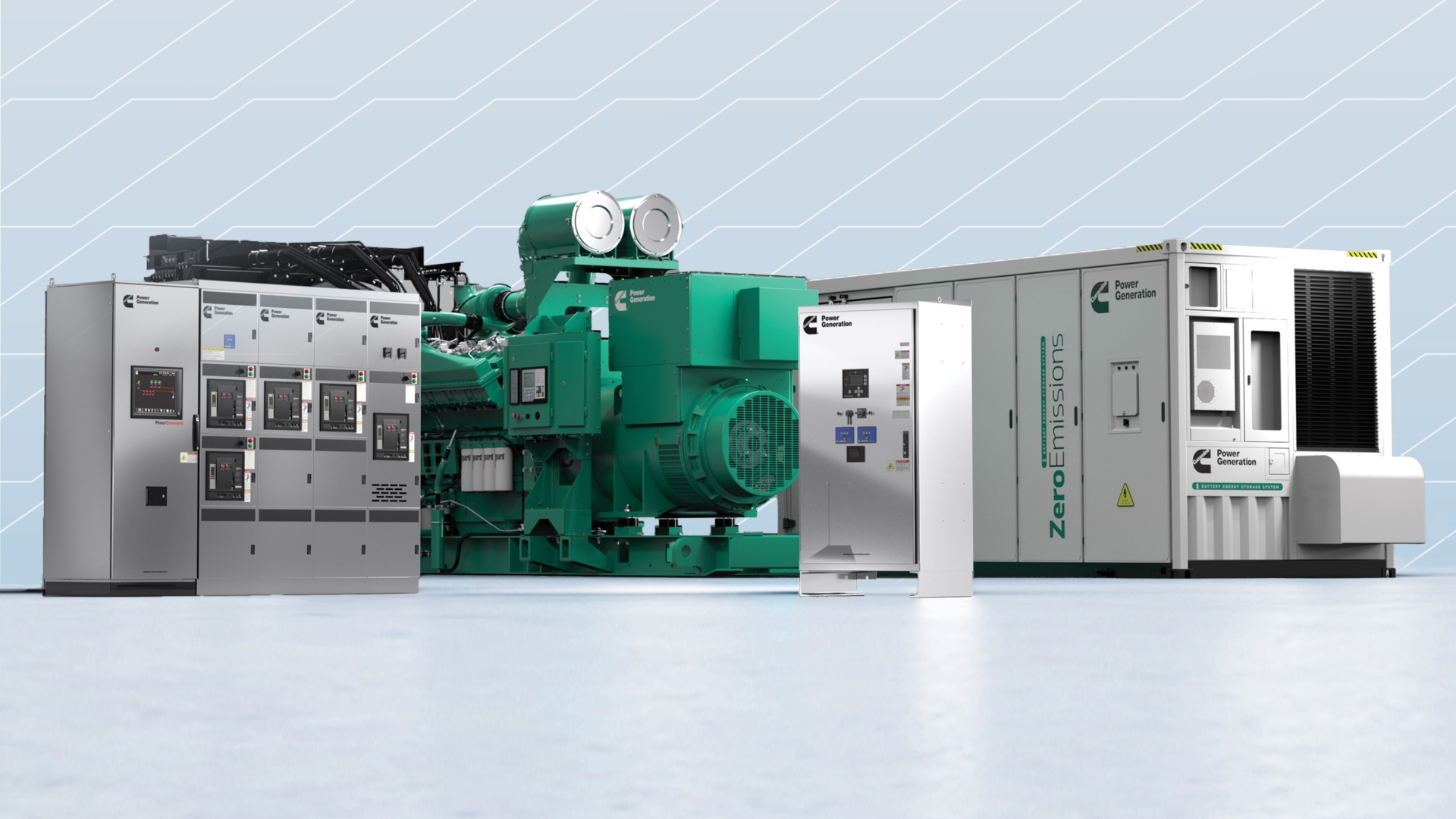
In this episode of Power Onward, Kim talks with Lucio Kroll and Aaron Gold about how BESS, generator sets, renewables, controls, and the grid can work together to create more flexible, reliable power systems.
From testing integrated systems at Cummins’ Power Integration Center to cutting diesel use, reducing outage risk, and supporting data center and AI loads, Lucio and Aaron explore how integrated power strategies can improve reliability, lower costs, and meet growing energy demands.
Watch
Additional resources
-
Why battery storage is now essential to microgrid development
-
In-Depth exploration of Cummins Microgrid testing lab, the Power Integration Center (PIC)
Interested in learning more? Subscribe to the 3-minute Power Up to get breakthrough stories and the latest innovations in power technology delivered straight to your inbox.
Timestamps
(00:00) Designing power systems for a changing energy landscape
(01:00) Three things to know about BESS today
(03:00) Why integration matters more than choosing a single technology
(04:00) Solving reliability, sustainability, and cost challenges together
(07:00) How the Power Integration Center proves complex systems will work
(10:00) Turning energy independence into a competitive advantage
(14:00) How BESS creates business value beyond backup power
(17:00) Pairing BESS with generators and solar for greater efficiency
(20:00) Cutting diesel consumption by 67% with a small BESS
(22:00) Why integration and flexibility will define the future of power
(24:00) Data centers, AI loads, and the need for millisecond response
(26:00) Start with the customer problem, not the technology
Listen
Apple Podcasts | Spotify | Amazon Music
Transcript
Episode transcript
Show ID (00:03):
Welcome to Power Onward, the podcast that pulls back the curtain on the technologies, people, and partnerships shaping the future of power.
Kim (00:13):
How do you design power systems in a world that's constantly changing? Grid constraints, evolving regulations, and rapidly changing customer needs have made designing reliable power systems more complex than ever. So what combination of solution actually works? The answer isn't the same for every customer, but that's exactly the point. The real advantage comes from how those technologies work together, not any single technology. Today, we're exploring how battery storage, renewables, and other power solutions come together to help customers navigate an increasingly complex energy landscape. I'm Kim.
Lucio (00:48):
Hello everyone. I'm Lucio, senior director at NewEnergy Solutions for Cummins.
Aaron (00:54):
And I'm Aaron, and I'm a marketing manager for New Energy Solutions at Cummins.
Kim (00:58):
Aaron, welcome back to the Power Onward Podcast. Last year you joined us and you gave us the download on BESS when it initially launched. So before we dive deeper into this episode, could you give us the top three things we should know about BESS today?
Aaron (01:09):
Sure. Well, first of all, thanks for having me back. It's been a pleasure. BESS is an energy management device. It is not an energy creating device. So it allows you to pair with, for example, renewables and use that energy more efficiently. It allows you to really drive your whole system to have peak efficiency with all of the energy that you have. And we're starting to see use cases across commercial and industrial, large things like data center, AI. I think the use cases just keep growing and we're going to continue to see BESS really playing a leading role in these large systems that are coming out.
Kim (01:47):
It's good to see that it's been so encouraging to see the growth because last time we spoke, we talked about how safe, scalable, and reliable the energy storage is. And I love that you present BESS as not just the missing piece, it's the actual piece that makes everything else fit together and work together better.
Aaron (02:05):
Absolutely. It allows you to have energy when you want, where you want, and very quick access to it right under 100 milliseconds in access to
Kim (02:14):
It. So truly plug and play. Awesome. So now that we have a baseline on BESS, let's open the aperture a bit. Lucio, what are you hearing from customers today and how have those conversations evolved over the last few years?
Lucio (02:27):
Thanks for the question, Kim. It used to be about choosing the right technology. Now the market evolves and it's all about designing the right solution, which involves multiple technologies. So customers are no longer relying on a single technology. Now the market requires a integrated system. I think the key word here is integration.
Kim (02:54):
We know that BESS is easy to install, transport ready. It works on grid and off grid, and now our customers are finally seeing it's not just about we need BESS. It's we need BESS to improve our operations.
Lucio (03:05):
Exactly. BESS contributes with improving the system performance, improve with cost savings, improves by adding flexibility to the system. So it becomes a critical component in a power generation solution.
Kim (03:20):
So when customers partner with Cummins, they're trying to solve a specific challenge. I'm hearing about reliability, operational costs, sustainability. At what point do they realize that the bigger opportunity isn't just solving that one specific challenge, it's redesigning their entire power system to optimize their operations?
Lucio (03:38):
You're right. Historically, customers, they think about, "I need to solve a particular problem. Oh, I need better reliability. I need to address sustainability targets. I need to address cost savings." So the conversation evolves or the conversation changes once they realize that it's not about one problem. You can address multiple problems. They're all connected, so they're all intertwined. So you can develop a solution that you don't have to make a decision between one over another. So you can actually design a solution that tackles multiple issues. So you don't have to choose between sustainability or cost savings or reliability versus sustainability. So you can design a solution that tackles multiple problems. So the key is the integration, and that's one area where Cummins adds tremendous value because we can design the proper solution, a fully integrated solution that involves generator sets, involves storage or BESS, involves controls, and then on that solution will be capable of tackling multiple issues that the customer might be dealing with.
Kim (05:00):
So we're mitigating them having to evaluate trade-offs. You're saying there are really no trade-offs then.
Lucio (05:06):
Yeah, exactly. I mean, there's a lot of flexibility depending on what solution you are looking for, but you don't have to make data. How I compromise my cost because I'm going for more reliable systems. So you can design the perfect solution depending on the customer needs that addresses multiple issues.
Kim (05:27):
Aaron, do you have anything to add to that? Well,
Aaron (05:28):
That was a wonderful answer. I think just the context to add to it is I think we're kind of experiencing a paradigm shift in the market where people used to see energy as just something that was part of business. And I feel like we're getting to the part now where people are realizing, customers are realizing they can really be in charge of their own energy situation or journey. And so working with Cummins allows them to have all of the different DERs that we offer in a really well thought out solution that, like you said, checks out a lot of boxes, not just one or two.
Kim (06:06):
That's a great point. I think a lot of times for me, especially outside looking in, it's like, well, the grid constraints are there and it feels like we're helpless and there's nothing that we can do to help our customers. But truthfully, that's not the case at all. And you're saying they have the keys now to integrating fast into their power systems and changing the game for themselves.
Aaron (06:27):
Absolutely. Yeah, really being in charge of their own destiny as far as that goes.
Kim (06:31):
So with so many options available today, how do you help customers feel confident that they're making the right decision?
Lucio (06:38):
I think confidence is the key. So they are dealing with us and then we are proposing to them very complex systems involving multiple assets, multiple equipment. So very likely in their minds are, how do I know this is going work?
Kim (06:54):
Right. It feels theoretical because we're just looking at spec sheets and brochures, right?
Lucio (06:58):
It looks complicated. So that's the one key aspect that Cummins has as a major differentiator is we have something in our Frievely Minnesota manufacturing facility. We have a lab, it's called PIC. PIC stands for Power Integration Center. So in their lab, we can prove to our customers that the solution will work. And how we do that, we can replicate their site conditions, we can replicate the load profile, we can test, we can validate, and we can demonstrate to them how the system that we are recommending will perform. So that gives them confidence, that gives them a peace of mind that what they are considering will perform as expected.
Kim (07:48):
So at the Power Integration Center, we are actually capable of simulating that catalog of products they were hoping to see together and just seeing how they could be orchestrated together.
Lucio (07:59):
Exactly. And you can even simulate some unexpected events. What if there is a power outage? Oh, what if this system doesn't work? It's a very, very flexible lab and I'll used to simulate their loads, but also some events that they have to deal with as they are running the project. Right.
Kim (08:21):
Any unexpected matters could be weather, could be outages, whatever it is. So do you think they leave the PIC lab then feeling confident like, oh, Cummins is a trusted advisor. They're not just supplying my equipment, they're making sure it's foolproof.
Lucio (08:35):
It makes a huge difference. So being able to going from theory to something practical that they can see it, they can witness how it's going to work, how it's going to perform is a game changer. Since we have the lab, we always bring customers, do the demonstration, and that actually helps them to build their confidence level on our solution.
Kim (08:58):
The lab is a brilliant idea. I'm thinking in terms of sports because you guys know me, I love my sports. You said it's a game changer. Now coaches can make plays that theoretically look great on the clipboard, but when you actually see the play running in action, that's when you can see the differences and even optimize. So I'm sure you might see something in the PIC lab that you say, oh, didn't expect that to happen. Let us show you how to mitigate that or avoid that in itself.
Lucio (09:22):
Exactly.
Kim (09:22):
Very cool. Very cool. So Aaron, do you think that the customers then reach a point where they're like, okay, battery energy storage systems or BESS aren't just a nice to have. It's kind of a strategic advantage. I
Aaron (09:35):
Think that we are really to that point now. I think that really, if you don't have BESS or your own access to power, if you're relying on the grid or you're relying on renewables that are only available part-time, you're really constraining the whole of your business. But if you are, let's call it energy independent, so to speak, then you really can start to have some serious strategic advantages over competitors. You have less downtime, you have less expense, maybe you're selling some energy back to the grid. There's a lot of opportunities with this that when added together really become a substantial difference maker.
Kim (10:18):
It's incredibly encouraging just because in the news I do feel like there's this shadow on our industry right now, but I think it's brilliant that customers aren't just buying products with us. We take them to the power integration center. They're investing in the confidence that their system will not just perform, but will really help their businesses bottom line.
Aaron (10:36):
Yeah, absolutely. I think it's actually really a competitive differentiator for those companies going forward.
Kim (10:43):
Aaron, you have to tell me more. Why is it a competitive differentiator?
Aaron (10:47):
To put it simply right, if I were going out to buy a project or buy, let's say I'm buying a massive manufacturing order and I'm aware of the grid constraints, and maybe I'm aware that one supplier I'm talking to is relying on the grid and another supplier is completely in charge of their own energy, then I know that, first of all, there are way less risks. There's almost certainly going to be significantly less downtime if something does happen. They're probably thinking more thoroughly about the cost of everything they're doing. And just overall, I think it shows an attentiveness to being able, I guess, to control your controllables for that company. And so it makes you feel more confident in going to them because they are going to have less questions, less random pop-up issues that may occur.
Lucio (11:38):
In addition to what Aaron's mentioned, access to power is directly correlated to business growth and business continuity. If you don't have power, you won't be able to run your business. And if you don't have enough power, you won't be able to grow your business. So I think I like his analogy when I say if you're relying on a supplier, one of the suppliers is rely on the grid only and the other one has an integrated system that relies on the grid but has a system that can compliment the grid and works with the grid. You know that you're not going to have issues with the second one because he's perfected. So that means when you need your supplies from them, you're going to get it. While the other one, all it takes is a fire outage then delays your delivery. So it is, like I said, power is directly tied to business continuity and business growth.
Kim (12:36):
Is this similar to what I keep hearing about bring your own power or it's a different concept?
Lucio (12:41):
It's related. Bringing your own power is a way for you to not only rely on the grid. So there is a difference between being completely in island mode versus having power in parallel to the grid. The demand for power is increasing exponentially, data center boom, unprecedent power demand. So that means the utility cannot keep up. I'd say they are investing, but they cannot keep up with the growth of the industry. So companies kind of don't have a choice. In order for them to ensure business continuity and business growth, they have to make some investments on their own power generation solutions. Otherwise, some of their investments might have to be delayed because the utility cannot keep up.
Kim (13:37):
Thank you for the clarity. I think that paints a beautiful picture. So it's clear that it always comes down to the bottom line for our customers as it should. So how do we continue to drive that business value for them driving towards their outcomes or business outcomes?
Aaron (13:51):
I think one of the things that we do that adds to our package at Cummins is we do a lot of modeling for customers, and so we're able to see where their benefits really look like they might come before we actually do the project. But a lot of times things we're looking at are, the most obvious one I think is downtime. People are afraid of downtime because it is probably the single biggest not random factor that can affect
(14:20):
Your business or your overall production. I think that there are a lot of other things that come with best that people don't always consider because I think we've almost been trained to see, like mentioned earlier, that there's one problem that we're fixing, but really this can solve a lot of them. So one of them is something like energy arbitrage. So let's say you have your own massive microgrid, your own integrated system or you're generating a significant amount of power. You actually, if you have excess power, assuming you're contracted with the utility, you can sell power back to them. So there's an even additional, traditionally that power would just disappear into nothingness. So now not only are you essentially making some money for that, but if you want to think on a bigger scale, you're easing the burden for the people. You're producing more energy for people to consume and hopefully keeping household prices down a little bit.
(15:18):
I think there are some challenges with loads now. So the loads that we are seeing are becoming more and more unique. So data center loads are very different from a commercial or industrial manufacturing site load, and BESS allows you to smooth either of those loads. It allows you to keep your energy generation as efficient and effective and turned off as much as possible too. So it allows you to really take all the energy you have, put it to its best use. It also allows you to change some of the other assets that you might be using. So if you're using a gen set plus BESS, traditionally, if you have something that has an extremely peaky load, you need to size the gen set for that load. So you may have a gen set that's way overqualified for 95% of its use, which means it's going to run less efficiently, use more diesel, et cetera.
(16:14):
And this really allows you to take a step back and say, "Actually, this is what I need, and now I have two variables to play with to make the perfect solution."
Lucio (16:23):
Well said. Well said. I would compliment the example on the gen set I think is perfect. Historically, you have to size the gen set to the highest load. Now with BESS complementing the gen set, you can then allow the gen set to run at the optimal load, not at the peak. By running at the optimal load, you are saving on fuel and you are extending the life of the gen set while BESS will handle the peaks. So it's kind of what we say load smoothing. And so that's one of the benefits of BESS. The other thing, when you have solar, so let's say you deploy solar in your roof, solar is going to use or lose. So if you're not using, you don't have BESS, you are going to be losing the excess power. So when you combine solar with BESS, now you can use the excess that you have from solar production and then store in Navari and then eventually use that later in the day.
Aaron (17:29):
We actually have a really good example of this in one of our use cases in Dubai. Okay,
Kim (17:35):
Tell me more.
Aaron (17:36):
We put BESS in a corporate site there and they have intentions to add solar, but they didn't have solar yet. They have a grid that was kind of weak. And even though it was a bunch of sort of unique variables, we were still able to figure it out and make it work. And I think they ended up with a three or four year payback. So keep in mind, this is a 10-year asset life in terms of at 10 years you're at 80% of that of state of health. So there's still life even after our state of life.
Kim (18:11):
It's incredible how an investment in such a beautiful design and making sure you have all the right pieces becomes very lucrative and provides that convenience. Because I do remember having a couple of meetings with some folks in Dubai and their wifi goes out, AC goes out. It's incredibly hot and it's incredibly dark, but with BESS, especially at that corporate site, they don't have to worry about those issues anymore.
Lucio (18:34):
There is another project that's quite interesting, a little bit different use case, but I think it's also relevant to share. We have a site, this particular site, it could not afford even a very quick power outage. The moment we have the power outage, you lose your entire production batch. So that means the time is, even if you have a gen set as a backup, time it takes for the gen set, which is usually within 10 seconds, you lose the entire, you have to restart over. So when you add BESS, BESS reacts in milliseconds, so the problem is gone. So you still have the gen set if you need a very long extended power outage, but for that very quick reaction, BESS, it's way superior than a gen set.
Kim (19:24):
That's flexibility at its finest, truly.
Aaron (19:26):
Absolutely. That's why we talk about them as great partners too, right? Genset handles the long need, BESS handles the interim period.
Kim (19:36):
Right. Again, those unexpected moments.
Lucio (19:39):
A lot of times people ask if BESS replaced Genset. I think they compliment each other. They're not like, "Do I need to choose Gensets or BESS?" I think BESS solution combines both.
Kim (19:51):
Dynamic duo. Absolutely. It makes all the sense in the world. When we talk about savings, are you able to throw out any values of how much we're seeing our customers save using BESS?
Aaron (20:03):
So going back to that same use case, they had three prime diesel generators that they were using for their facilities throughout the day. By implementing one small BESS, by the way, this is a small BESS, a 200. Oh, I
Kim (20:17):
Was going to say, tell me a little bit more by small
Aaron (20:20):
BESS. At 400 kilowatt hour, we were able to reduce diesel consumption by 67% across those three units. So that was something like $30,000 a year. There's also typically with Gensets maintenance overhaul that occurs every X amount of time.
Kim (20:38):
I feel like the more we talk about BESS and integrating BESS within our power systems, it just keeps getting better and better. And so now we spent a lot of time talking about BESS in the industry today, but what do you guys think will define the next few years of power generation?
Lucio (20:53):
I would say it's all about integration and flexibility because as you asked, your first question is what is different today versus five years ago? Now people are no longer relying on a single technology. They are integrating multiple technologies. And then one thing that we see that's common across the board is BESS. So you might have a gen set and likely going to have BESS as well. You might have solar, you're going to have BESS, you might have all the above. So it's a lot of equipment's to be integrated and that's not going to change. It's going to become more and more technologies that as technology evolves and new technologies come up, you have to do that integration. BESS has a tremendous momentum, is gaining a lot of adoption across
Kim (21:40):
The industry. Easy to see
Lucio (21:41):
Why. Because of how flexible it is and how many different benefits it offers. This high growth that we're seeing from BESS is not a temporary thing. It's going to continue for many years to come. And as I mentioned, as other technologies evolve and are being released, I still believe that BESS is going to be part of the solution.
Aaron (22:04):
Could not agree more. So you're seeing improvements in BESS too, right? Energy density, size footprint, all of that. Totally. But a lot of the energy generating devices, we're seeing a lot of improvements. And I think as maybe in 10 years there's some new energy generation device that is just far superior, maybe not, but maybe.
Show ID (22:26):
Never know.
Aaron (22:27):
Either way, BESS is critical in either situation, even if it remains exactly the same, even if it evolves into something where everyone has their own handheld nuclear power plant, having the ability to time and condition the power that you have is going to be critical for I think everybody.
Kim (22:48):
Do you think it will continue to expand? I know we are playing in a lot of different industries now with mission critical, industrial. Do you think the use cases will further expand?
Lucio (22:57):
Absolutely. Yeah. AI training, data centers with this unprecedented growth. There is obviously cloud computing. We're using data all the time, taking pictures, taking selves, watching videos on YouTube. So the data is growing exponentially, which means they need more power and they need more data centers, they need more power. On the top of the typical cloud computing, you also have AI training, which they are developing those AI models. And on the top of this, you have the AI inference, which is when the models are already released. All this needs power. And then we start seeing quite a lot of opportunities, a lot of data centers approaching us requesting quotations to include BESS in those sites. Historically, our company used to sell a lot of agen sets for standby applications. Now we continue to do the same, but also we start now offAarong BESS to those customers.
(23:53):
So that's another massive market that is growing.
Kim (23:57):
100%.
Lucio (23:59):
Growing very quickly, and now they are adopting BESS. Why do they need BESS? Because BESS reacts very quickly and then AI, if there is one thing that is very common in AI sites is frequent peaks, a lot of peaks and then they happen all the time. So the utility, it's pretty problematic for Utility to handle all those variations in the load and also for a Genset because it takes times to react. BESS can handle those in milliseconds.
Kim (24:28):
It's incredible. Expanding into data centers is a huge opportunity. I can't stress that at all. So for customers trying to navigate industry complexities, but maybe they don't want to over commit to a single product or a single concept, what is the best advice that you can give them today?
Aaron (24:43):
I think my honest best advice would be come with a bit of an open mind when you're looking for a solution. I think solutions have evolved significantly in the last decade or two decades even, but even in the last couple years, the incorporation of BESS or higher natural gas engines, things like this, people originally would come with a problem or two maybe in mind that they want to solve. It would be kind of wild to go in thinking, "I have five problems. I'm going to solve all five of them with this solution." Now you can. You just need to be a little bit more creative. I would also say work with somebody like Cummins who can walk you through that. We're here, we've been here for a hundred years. We've done a lot of projects in that time.
Kim (25:30):
Oh yeah.
Aaron (25:31):
We have a lot of different assets that we can add, and we're very thoughtful about the way we put stuff together. And we really, really want to see our customers succeed. It's really time to consult an expert because it's more complicated and you're going to get more value out of your solution than probably ever before.
Kim (25:48):
Okay. So partner early and design for flexibility, major keys to success.
Lucio (25:52):
I would say quite often, Kim, we see projects that begin with a technology mind, trying to find a problem to solve. So you kind of already approach a customer with, "I need to sell this to them." So you are trying to find how can I sell this solution to them? That's the wrong approach. You need to understand what the customer's challenge are and then design the solution, not trying to, "I have this technology in mind, so let me figure out a problem that I can solve." So start with understanding what are the challenges, what the customer is trying to accomplish, then you design. That's why I like his answer about being open-minded on this solution, not trying to say, "I'm here today to sell a gen set." No, you're here today to solve the customer problem. It might involve gen set. It might not. Very likely we involve BESS, but anyway, that's my recommendation.
Kim (26:53):
I like that listening. Listening is where we actually get the most. It's like the customers are then telling us the recipe, the ingredients for how to actually better serve them.
Aaron (27:03):
Yes, exactly.
Kim (27:04):
All right. Well, before I let you guys go, I do want to play a quick game of this or that. And the idea is just to see where you stand on some of the biggest trade-offs in the industry today. So I'll give two options and then you each tell me which one wins. Ready? Reliability or flexibility?
Lucio (27:21):
I would say reliability because if you don't have a reliable system, nothing else matters.
Kim (27:26):
Aaron?
Aaron (27:26):
I think short term it's reliability. I think long-term it's flexibility.
Kim (27:30):
Okay.
Aaron (27:31):
And I think people, going back to the last question a little bit, people need to maybe also zoom out on what is the length of time that this solution is fitting, right? Maybe this is something that solves a lot of problems for 15 years for you rather than just the next few.
Kim (27:47):
Okay. Okay. Speed to power or long-term optimization?
Lucio (27:52):
I think it depends on the customer.
Kim (27:54):
Okay. If
Lucio (27:54):
You talk to any data center today, speed to power, this is what matters. They need power today, not three to seven. They needed it yesterday. Yeah. However, as soon as you address the speed to power, then they want, right?
Kim (28:08):
Yep. They want the long-term optimization. Exactly.
Lucio (28:10):
Because the long-term optimization is what's going to drive the total cost of ownership.
Kim (28:15):
Right.
Lucio (28:16):
But in the short-term, if you say I can give you the perfect solution, but have to wait two years, then no, they meet today.
Kim (28:21):
We're not waiting. They're not waiting.
Lucio (28:23):
So it's need to power, but eventually the long-term optimization.
Kim (28:27):
I totally
Aaron (28:27):
Agree. Yep, totally agree. You don't have to pick anymore. You might be able to get both. You might be able to get all of these.
Kim (28:34):
Crazy. I want to go shopping with you guys. I feel like then I get everything I want.
Aaron (28:37):
As long as it's not sale. Yeah.
Kim (28:39):
It's done. All right. Got it. Okay. Couple more. Grid power or onsite
Lucio (28:44):
Generation? I think you need both. I know that's not why you ask, but - I'll take both. You need both.
Kim (28:52):
You can stand on business as to why. I'm all ears.
Lucio (28:56):
The demand for power is outpacing how fast grid can provide power. If you just rely on the grid, pretty risky because at certain point you might have to deal with a frequent power outage. Will grid never catch up? Hard to say. They are working hard to do so, but we don't know how long it's going to take. So I think you need both. You need to rely on the grid in combination with our onsite generation.
Aaron (29:23):
I would again say I agree. I would push a little bit towards independence because I think we're in a time now where everything is so intertwined and -
Kim (29:36):
It's like a domino effect. If one thing goes wrong, you're kind of just uncertain.
Aaron (29:39):
Right. And a lot of companies have made a lot of improvements in a lot of the things they do, so you're looking for competitive advantages for your company. And I still think that this is something that can provide a serious competitive advantage going forward. And so I think that's where I land.
Kim (29:56):
Okay. And the final one, proven technology. Or emerging innovation?
Aaron (30:02):
Well, we have a hundred years of proven technology, so I would be amiss to say that doesn't matter. Like I said, I think we're in a bit of a paradigm shift. I think we're in a time period where what was working for a really long time is not going to be enough anymore. And so we shouldn't get rid of those old technologies and maybe we use that as a foundation. So this is a perfect application for gen set plus BESS. So you have the foundational that we know has -
Kim (30:29):
The tried and true.
Aaron (30:29):
Yeah, exactly. And now we have this additional piece that we can tie in with it and make them both better. So I think very slightly emerging technologies, but you need to have a foundation.
Kim (30:40):
Lucio, what's your positioning on this? Proven tech or emerging innovation?
Lucio (30:44):
I actually go the other way around. I would say let's go with a proven technology as the foundation and then using the innovative technologies where it clears add value because innovative technologies, they have some risks. They're still not proven. So I'll go that way. Proven and adding the innovative technologies when you absolutely convinced that's going to add value, unless you are willing to take some risks.
Kim (31:16):
Not sure how many people are willing to take risks. So I'm actually, if I may put my two cents in, I want to go with proven tech as well. But I do know that at Cummins we have an uncanny ability to really fortify those frontier technologies and then making them proven themselves. So both, but I'm going to say proven. You know what I'm saying?
Aaron (31:34):
If you add the pic lab to it, right? Absolutely. Then is it proven already? Maybe we're all in agreement anyway.
Kim (31:40):
See, we swayed him. We persuaded Aaron. All right. Well, Lucio, Aaron, thank you so much for joining us today and showing us that Cummins helps customer kind of navigate that complexity by offAarong more paths forward than they initially thought, the many paths forward approach, if you will.
Aaron (31:56):
Thanks for having us. Thank you. Pleasure having us.
Kim (31:59):
Thank you. All right. So what's the big idea for this episode? In a world where demand is growing, regulations are evolving and uncertainty is becoming the new norm. Customers don't need more complexity. They need confidence. And confidence comes from knowing your power system is designed to adapt today, tomorrow, and onward.
Show ID (32:19):
Thank you for listening to Power Onward. Your support means the world to us. If you enjoyed this episode, please don't forget to subscribe, rate and review on your favorite podcast platform. If you want to dig deeper on what we covered today, check out the show notes for additional links or go to cummins.com/podcast. Until next time, Power Onward. We're from Cummins, the company that's been innovating toward the future for more than a hundred years. We're no strangers to rapid change, global shifts, and economic uncertainty. We want to be your constant during the energy transition whenever, wherever, forever, Power Onward.
For more episodes, check out cummins.com/podcast. Want to join us on our mission towards smarter, cleaner power? Check out cummins.com/careers to explore opportunities.
Author Profiles