How natural gas engines lower total cost of ownership for commercial fleets

Summary
Natural gas vehicles (NGVs) can offer commercial fleets significant fuel cost savings compared to diesel, with compressed natural gas (CNG) averaging $2.99 per diesel gallon equivalent versus $4.25 for diesel as of April 2023, and stable domestic pricing that makes monthly budgeting more predictable.
While NGVs carry a higher upfront purchase cost, government incentives available in nearly every state, plus the elimination of expensive diesel aftertreatment systems, help reduce maintenance costs to offset that premium over time.
With over 30 years of experience designing and manufacturing natural gas engines for truck and bus applications, Cummins is the perfect partner for businesses and fleets looking to switch from diesel or gasoline.
Learn how natural gas engines can help fleets reduce the total cost of ownership.
Natural gas vehicles vs. diesel vehicles: Total cost of ownership comparison
| Category | Natural gas vehicles (NGVs) | Diesel vehicles |
|---|---|---|
| Initial purchase cost | Higher than diesel | Lower than NGV |
| Infrastructure cost | May require a new CNG refueling station and safety upgrades. Costs can often be absorbed into fuel supplier contract. | Established fueling network widely available |
| Emissions aftertreatment | Not required | Routine exhaust gas aftertreatments required |
| Overall maintenance cost | Slightly more expensive | Lower |
| Spark plugs | More frequent monitoring and replacement required | Not applicable |
| Fuel tank inspection | More frequent CNG tank inspection recommended | Standard inspection |
| Renewable fuel option | Renewable natural gas (RNG). Please always check with your OEM and vehicle manual. | Renewable diesel. Please always check with your OEM and vehicle manual. |
Natural gas engines do have a higher initial cost compared to diesel engines
Initial purchase costs are a significant factor when looking at a vehicle’s total cost of ownership, so the higher purchase price of a natural gas vehicle does need to be considered. The upfront costs of an NGV are normally higher than the costs of a comparable vehicle with a diesel engine. In addition to purchasing the vehicle itself, businesses may also include additional infrastructure costs. These include building a natural gas refueling station if they choose to have a behind-the-fence solution, and the cost associated with upgrading maintenance locations to meet natural gas safety standards.
Fortunately, there are a number of incentives offered by federal and state governments to help businesses offset costs associated with switching to NGVs. In fact, nearly every state government offers some form of NGV incentives. These include grants, tax deductions or credits, fuel tax reductions, reduced license fees, lower vehicle sale taxes and lower vehicle registration fees.
And the upfront infrastructure costs for the fueling equipment can be absorbed into a contract with a natural gas fuel supplier, so a fleet doesn’t have any initial out of pocket costs.
Natural gas engines offer fuel savings
NGV owners generally pay less for fuel than if they own diesel and gasoline vehicles. That’s partly because U.S. natural gas is abundant and doesn’t experience the cyclical boom and bust periods that affect the petroleum industry. The retail price of natural gas has also historically been lower than that of diesel and gasoline. As a result, companies that use a lot of fuel are less likely to pass fuel price increases onto consumers if using natural gas engines.
Since natural gas consumed in the United States is largely produced and sold domestically, the price of natural gas is not as volatile or tied to the market fluctuations and geopolitical shocks that affect crude oil-based fuels. Because the cost of fuel is relatively stable, it makes forecasting monthly fuel expenses easier. In fact, the retail price of a diesel gallon equivalent of CNG stayed almost flat between April 2011 ($2.09) and April 2021 ($2.19). It’s only been in the last few years that retail prices of CNG have started to slowly creep up.
The Department of Energy tracks the price of various fuel types. According to their latest report, Between April 1 and April 15, 2023, the national average price of diesel fuel in the United States was $4.25 per gallon. The national average price of compressed natural gas (CNG) in that same timeframe was $2.99 per diesel gallon equivalent (DGE). This difference in price would save a fleet $12,600 each year by running on CNG over 10,000 DGE of compressed natural gas. The more miles a company drives in a year, the greater its fuel cost savings will be. And those are just looking at retail prices. For fleets refueling behind the fence, fuel costs are often much lower. It’s important to check with a preferred fuel supplier to get a contract built around how much fuel you expect your fleet will use.
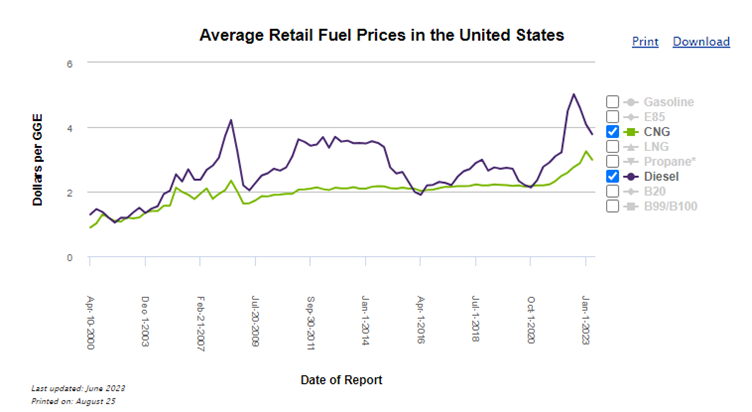
Knowing how much fuel you plan to use over the life of the vehicle will also help you calculate the breakeven point on recouping that higher upfront vehicle cost.
Additional fuel cost savings can come from renewable natural gas (RNG). RNG can participate in the renewable fuel standard program by the US Environmental Protection Agency. Refuse companies can even offset their fuel costs when using RNG generated from biogases captured from their landfills.
Maintaining and servicing natural gas engines
Fuel costs are just one portion of ownership costs. Service and maintenance costs are a sizable expenditure over the life of a vehicle as well. NGV maintenance is often slightly more expensive overall compared to diesel vehicles, but certain aspects of maintenance will be cheaper than diesel or gasoline-powered vehicles.
An important reason for this is that, unlike diesel vehicles, NGVs do not require expensive exhaust aftertreatment systems to meet emissions standards. Diesel aftertreatment systems require diesel exhaust fluid (DEF) and Diesel Particulate Filters (DPF) that require a lot of preventative maintenance, such as regularly changing and cleaning filters. When they break, replacing or repairing them can be expensive. Because natural gas engines produce very small amounts of air pollutants, such systems are not needed.
On the other hand, NGVs require certain maintenance tasks and parts that are not required with diesel vehicles. For example, natural gas vehicle owners must inspect the fuel storage tank to ensure it is not damaged. Natural gas combustion is more sensitive to the quality of sparks, which requires more frequent monitoring and replacement to ensure good, working condition sparkplugs. The frequency of maintenance intervals also differs between diesel and natural gas vehicles. It is important to adhere to the recommended maintenance schedules for natural gas. Cummins is working on synchronizing maintenance intervals for the new X15N to do more service events at once and reduce downtime.
Natural gas engines offer a variety of cost-saving opportunities for businesses and fleets that are looking to switch from diesel or gasoline. With lower fuel expenses and reduced maintenance costs, NGVs are becoming the fuel of choice for many commercial and consumer vehicles. With Cummins' experience in designing and manufacturing natural gas engines, businesses can be sure that they are getting the best value for their money.
Frequently asked questions
- Fuel savings are the most significant factor. CNG averaged $2.99 per diesel gallon equivalent compared to $4.25 for diesel as of April 2023 which is a difference that generates approximately $12,600 in annual savings per 10,000 gallons used. Crucially, the more miles a fleet drives, the greater those savings become over time. For fleets refueling behind the fence, costs can be even lower through a negotiated supplier contract.
- Price stability compounds those savings over the long term. Because U.S. natural gas is largely produced and sold domestically, it is insulated from the oil market volatility and geopolitical shocks that cause diesel prices to fluctuate. CNG retail prices barely moved between 2011 and 2021, making long-term fuel cost forecasting far more reliable.
- Reduced aftertreatment costs provide another long-term benefit. Unlike diesel, natural gas engines do not require diesel exhaust fluid (DEF) or Diesel Particulate Filters (DPF) which are systems that demand regular maintenance and can be expensive to repair or replace.
- Government incentives help accelerate the return on the higher upfront investment, with nearly every state offering some combination of grants, tax credits, fuel tax reductions, and reduced registration or license fees.
- Renewable Natural Gas (RNG) offers an additional long-term cost offset, particularly for refuse companies that can generate RNG from their own landfill biogas and participate in the EPA's renewable fuel standard program.
Based on available government incentives, natural gas vehicles (NGVs) represent one pathway for commercial fleets looking to reduce emissions. Nearly every state offers some form of NGV incentive to help offset the higher upfront cost of switching from diesel. These incentives take several forms, including grants, tax deductions or credits, fuel tax reductions, reduced license fees, lower vehicle sales taxes, and lower vehicle registration fees.
At the federal level, the U.S. EPA's renewable fuel standard program provides an additional financial mechanism. Fleets running on renewable natural gas (RNG) can participate in the program, and refuse companies can even offset their fuel costs by using RNG generated from biogas captured at their own landfills.
Switching from diesel to natural gas engines can help reduce emissions from heavy-duty commercial truck engines. Natural gas engines produce very few air pollutants and do not require the exhaust aftertreatment systems that diesel engines need to meet emissions standards.
Yes, NGVs have a higher upfront purchase price than comparable diesel vehicles. However, government incentives, available in nearly every state, can help offset that cost through grants, tax credits, and reduced fees.
Based on April 2023 retail prices, CNG costs $2.99 per diesel gallon equivalent vs. $4.25 for diesel, a difference that adds up to roughly $12,600 in annual savings per 10,000 gallons used. The more miles your fleet drives, the greater the savings.
Author Profiles